Long History of Maritime Trade
Arab traders — especially those from Hadhramaut in Yemen — had been sailing through Southeast Asia for centuries before Raffles arrived. They were well known for trading:
- Spices
- Textiles
- Frankincense and myrrh
- Dates
- Perfumes
- Religious books
They were respected for their business networks and their role in spreading Islam across the Malay Archipelago.
Singapore Became a Free Port (1819)
When Raffles declared Singapore a free port, it attracted traders from all over Asia. Arab merchants saw a golden opportunity:
- No taxes
- Safe harbour
- A strategic location between India, China, and the Malay world
Religious and Cultural Links with the Malay World
Many Arab families had long-standing ties with Malay sultanates.
They were respected as:
So when Singapore opened as a new trading hub, they naturally followed the Malay community here.
The Influence of Sultan Hussein
The Arab community had close ties with Sultan Hussein Shah, who signed the treaty with Raffles. This relationship encouraged more Arabs to settle in Singapore.
Why Were the Arabs Assigned to Kampong Glam?
Under the 1822 Raffles Town Plan, ethnic groups were assigned specific zones to maintain order and support community life.
Kampong Glam Was the Malay & Muslim Quarter
Raffles designated Kampong Glam as the area for:
This was because these groups shared similar cultural and religious practices
Close to Sultan Hussein’s Istana (Palace)
The area around Istana Kampong Glam was meant to be the centre of Malay and Muslim life. Arabs, being respected Muslim merchants and scholars, were placed close to the Sultan’s residence.
Ideal for Trade
Kampong Glam was near the sea and the old shoreline (before land reclamation). Arab traders could easily:
This made it a perfect commercial hub.
Strengthening the Muslim Community
Raffles believed that grouping Muslim communities together would:
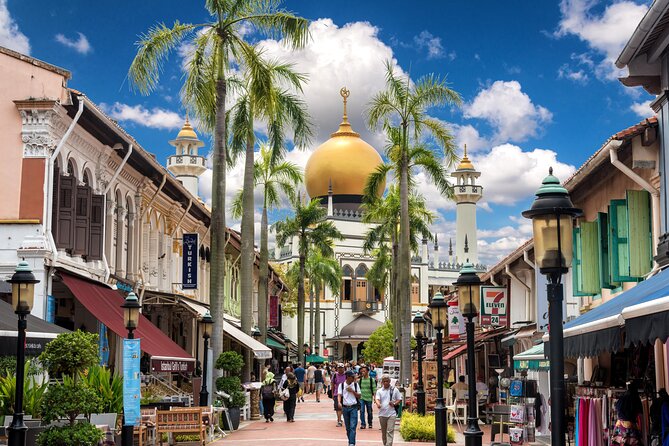
This is why the Sultan Mosque (Masjid Sultan) later became the heart of the district.
What the Arabs Contributed to Singapore
The Arab community played a major role in shaping early Singapore:
Business & Trade
They became successful merchants in:
Religious Leadership
Many were Islamic scholars who helped build mosques and madrasahs.
Philanthropy
Arab families such as the Aljunieds donated land for:
Their contributions are still visible today.
In Simple Terms
The Arabs came to Singapore because it was a booming free port with strong Muslim and Malay connections. They were assigned to Kampong Glam because it was the designated Muslim district, close to the Sultan, and ideal for trade. Their legacy lives on in the shophouses, mosques, and street names of Kampong Glam.
Location
Kampong Glam centred on Bussorah Street, Arab Street, Sultan Mosque and the historic Istana Kampong Glam.
Plan a Visit
Join one of our guided heritage walks to learn more about Kampong Glam's history and heritage. Private group bookings available.
Contact / Book a Visit